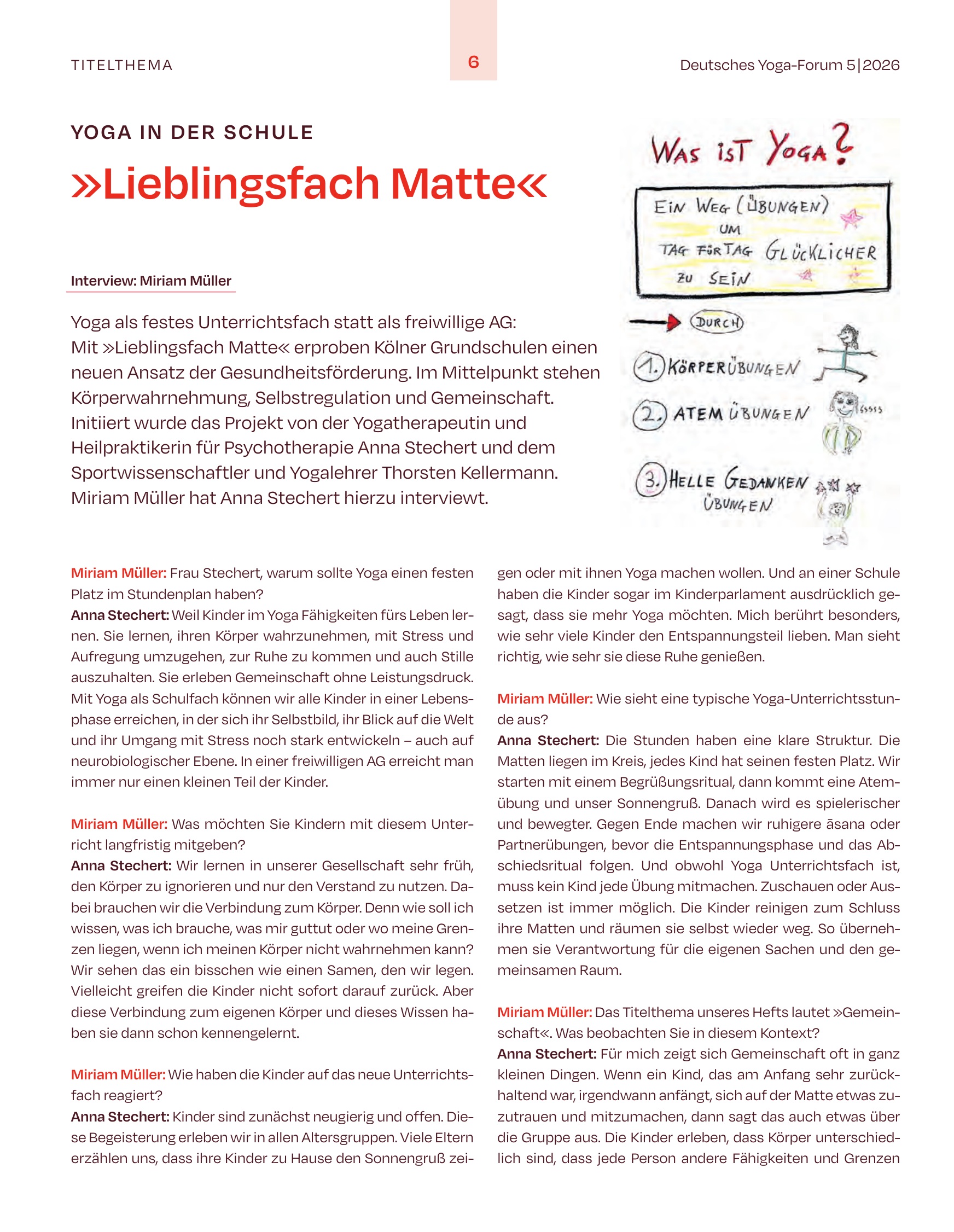
In the German Yoga Forum, I talk about my work with “Lieblingsfach Matte” (Favorite Subject: Yoga Mat) – and why, for me, yoga is far more than just physical movement.
Why should yoga have a permanent place in the school curriculum? What can children learn from it that will serve them throughout their lives? And what is required to ensure that yoga is not just a fleeting guest at a school, but rather a long-term part of everyday school life?
I had the opportunity to discuss these questions with Miriam Müller, editor-in-chief of the *Deutsches Yoga-Forum*. The interview appeared in issue 5/2026, which focused on the theme of “community.”
At the heart of the conversation is our school project, “Favorite Subject: Math” (*Lieblingsfach Matte*), which I co-lead with Thorsten Kellermann. At the same time, the discussion touches on many themes that shape my work as a whole: connecting with one’s own body, managing stress and tension, experiencing a sense of safety, and exploring how people can regain access to their own needs and boundaries.
For me, yoga is body work
As a yoga therapist and alternative practitioner for psychotherapy, I work primarily with people who are under great stress – for example due to depression, traumatic experiences or cancer. I experience again and again how difficult it can be to even perceive your own body and classify its signals.
Many people learn early on to disregard their physical needs and, above all, to “just function.” But how can I recognize what is good for me, when I need a break, or where my limits lie, if I barely perceive my own body?
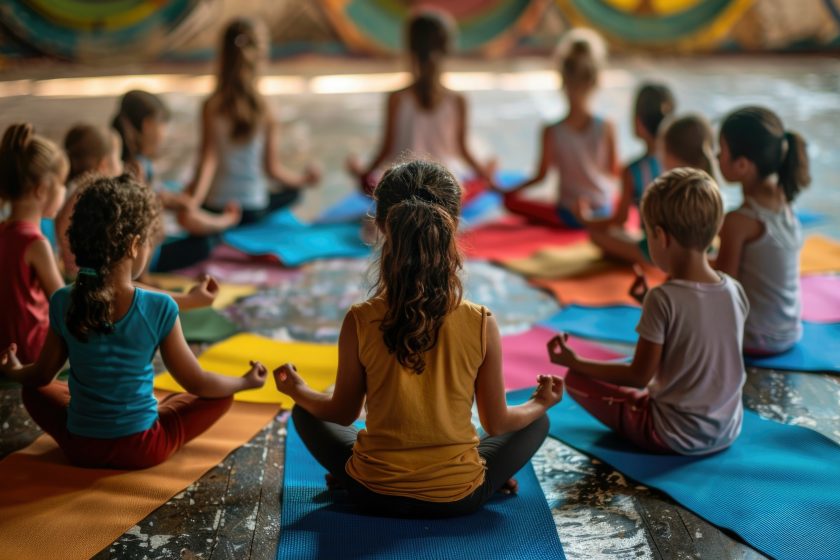
That is precisely why I believe that connecting with one’s own body is a skill children should be introduced to as early as possible. Yoga can provide them with a safe space where they can experience movement, stillness, and a sense of community—free from the pressure to perform.
Trauma-sensitivity begins with choices
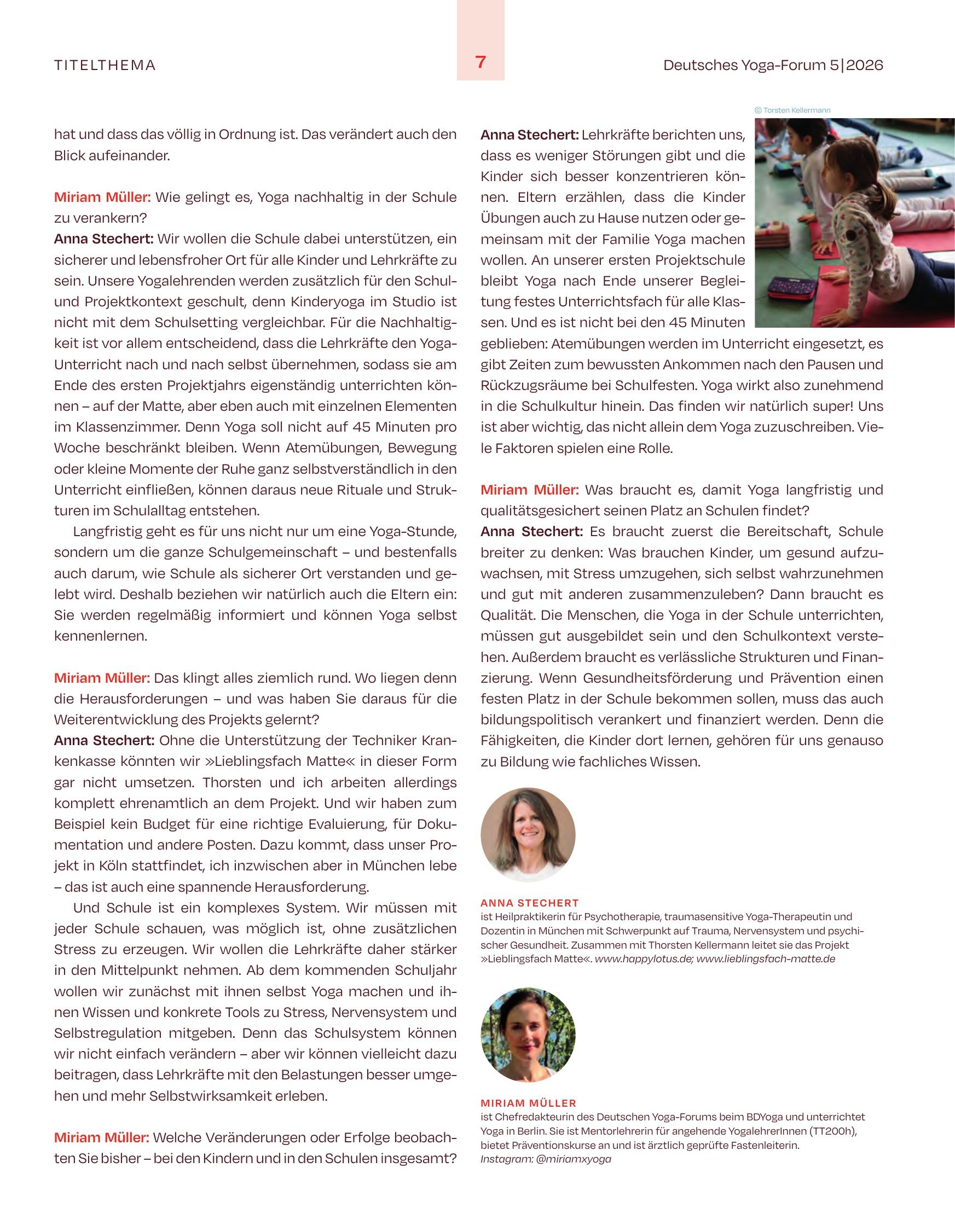
My trauma-sensitive approach also shapes the work in the school project. A yoga session requires a clear, reliable structure—while at the same time, the children are free to decide for themselves how they wish to participate.
No one is required to perform an exercise perfectly. It is also perfectly fine to simply watch, take a break, or choose a different variation. The goal is not for all children to do the exact same thing; rather, it is for them to learn that bodies differ, that people have different needs and limits, and that all of this is perfectly okay.
This experience can change not only one’s relationship with one’s own body, but also one’s perspective on others. For me, this represents an important aspect of community.
Conveying knowledge in an accessible and practical way
Another key focus of my work is to share information about stress, the nervous system, and self-regulation in a way that can be genuinely applied to everyday life. This applies equally to my therapeutic practice, my professional training sessions, and the support I provide to schools.
“Lieblingsfach Matte” (Favorite Subject: Mat) is therefore about more than just a single yoga session per week. Breathing exercises, brief physical activities, or intentional moments of grounding can also be integrated into regular lessons. These practices can help both children and teachers recognize stress earlier and regain their capacity to act.
It is important to me not to make exaggerated promises of effectiveness. Yoga does not solve all problems in the school system. But it can open up concrete opportunities to deal with stress differently and to experience moments of security, connection and self-efficacy.
Ensuring yoga remains in schools
Perhaps the most important lesson from the project’s years to date is this: sustainability cannot be achieved solely through external yoga instructors.
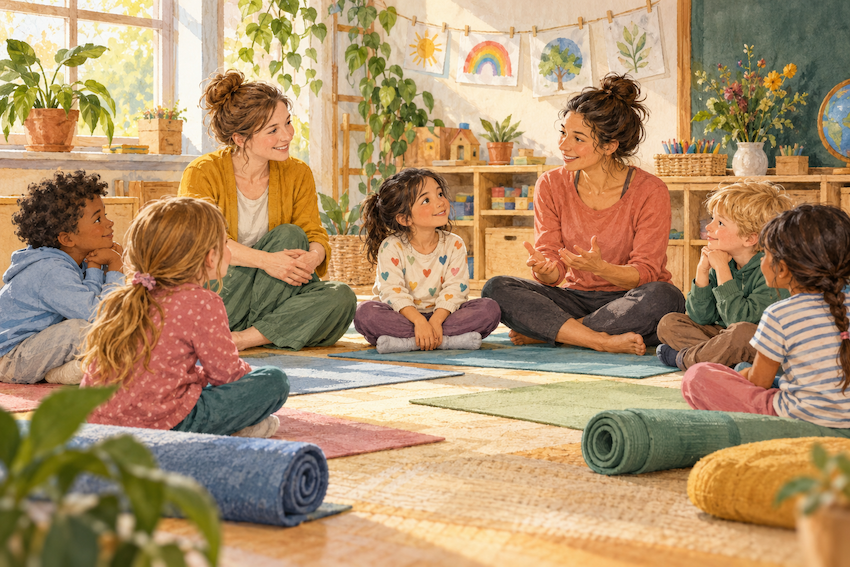
If yoga is to become a long-term part of the daily school routine, teachers must be involved. They know the children, build relationships, and shape the everyday life of the school. For this reason, we prepare them step by step to incorporate yoga elements—and eventually, entire yoga sessions—on their own.
Our goal is achieved when, at some point, a school no longer needs us.
At our first project school, we achieved exactly that: yoga has remained a permanent part of the curriculum, even after our direct support came to an end. Furthermore, teachers now naturally incorporate breathing exercises, intentional moments for settling in, and opportunities for quiet withdrawal into everyday school life.
To me, this illustrates what becomes possible when yoga is understood not merely as a sequence of exercises, but as part of a school culture that is attentive and promotes well-being.
The full interview
In the interview, I also discuss the specific structure of the yoga sessions, the children’s reactions, the challenges involved in the project, and the conditions necessary for establishing yoga in schools in a way that ensures quality.
My heartfelt thanks go to Miriam Müller and the German Yoga Forum for the detailed discussion and the space for this important topic.
The interview “Yoga in School – Favorite Subject: The Mat” appeared in *Deutsches Yoga-Forum* 5/2026.