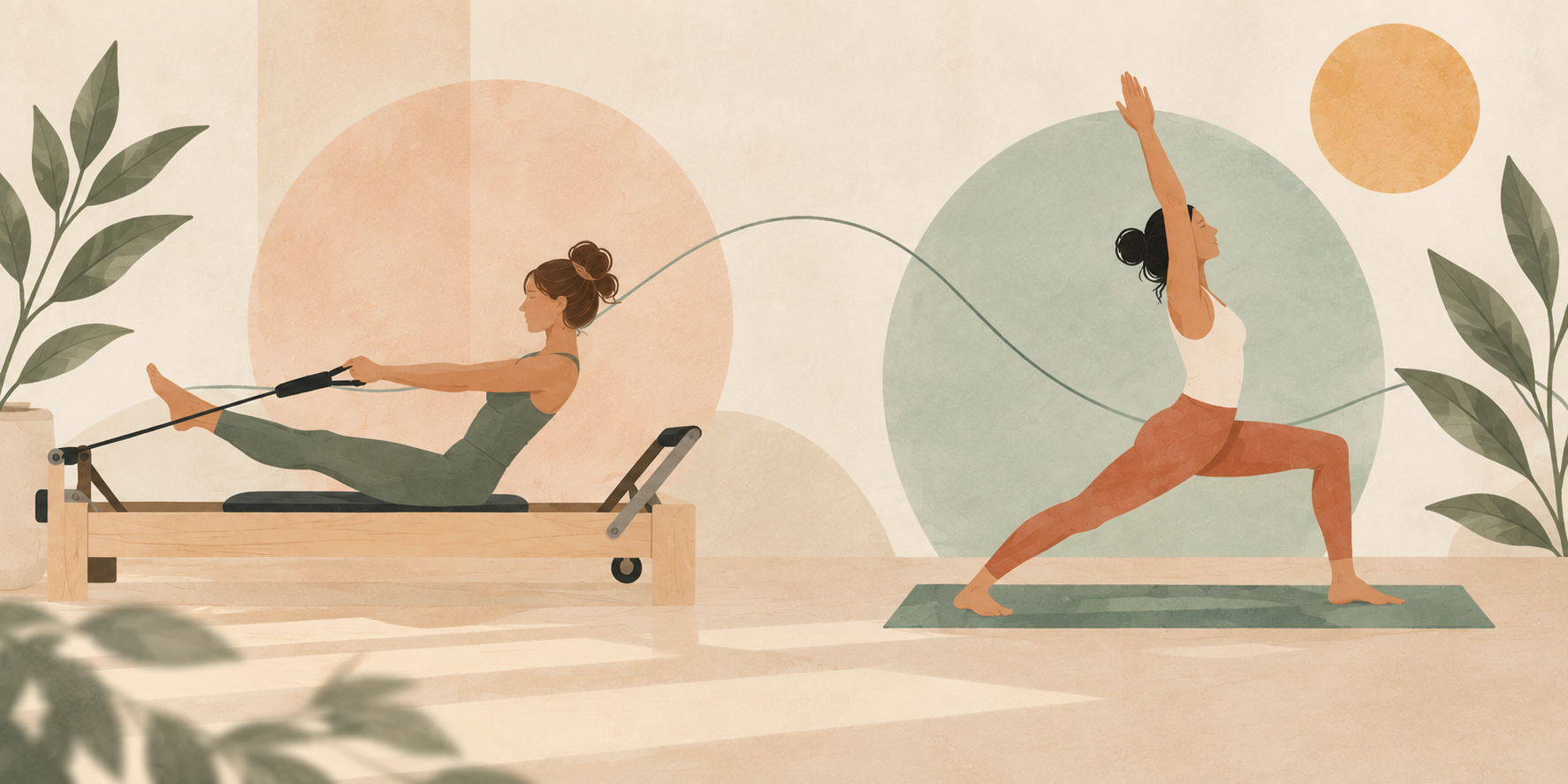
Pilates feels like it’s everywhere right now. New studios are opening, reformer classes are fully booked, and on social media, you suddenly see Pilates instead of Yoga again. Anyone who moves a bit in the fitness and wellness world might actually get the impression: Yoga was yesterday. Pilates is today.
Of course, I could regret that. But honestly, I don’t.
Because perhaps the Pilates boom is even a very good development for Yoga.
Pilates, by the way, is also much more than pure fitness training. The method has a holistic approach, where, in addition to physical movement, breathing, concentration, and body awareness play an important role. Nevertheless, Pilates is often marketed today as a sport, fitness, and lifestyle offering – and is currently extremely successful. Just as Yoga once was.
Perhaps this is precisely what invites us in Yoga to ask a question that is long overdue: What exactly is Yoga – if we don’t focus on the asanas for a moment?
Because the Yoga world is not entirely innocent in the fact that Yoga is often perceived today primarily as a physical practice. For many years, Yoga was primarily made visible through what is easiest to show: bodies in asanas. Sometimes acrobatic, sometimes relaxed, sometimes at sunset on the beach. Influencers, in skimpy outfits and with well-trained bodies, presented flexibility, strength, balance, and the perfect flow as the image of Yoga.
And at some point, a part of Yoga became Yoga itself in public perception.
But if Yoga is primarily asana practice, then it must indeed be comparable to Pilates, Barre, and other forms of training. Which training strengthens better? What makes you more flexible? What trains the core more effectively?
But perhaps that’s not the question Yoga needs to answer. Perhaps the current Pilates boom is, in fact, an opportunity for Yoga. Instead of trying to be the more attractive workout on the same playing field, we could refocus on what truly defines Yoga beyond the asanas – and why that might be more relevant today than ever.
Yoga is More Than What We See on the Mat
Of course, asanas are part of Yoga. And physical movement can be incredibly valuable. It can strengthen, mobilize, relieve pain, get us out of our heads and back into our bodies. So, it’s not about downplaying physical Yoga practice.
But Yoga doesn’t begin with downward-facing dog and doesn’t end with Savasana.
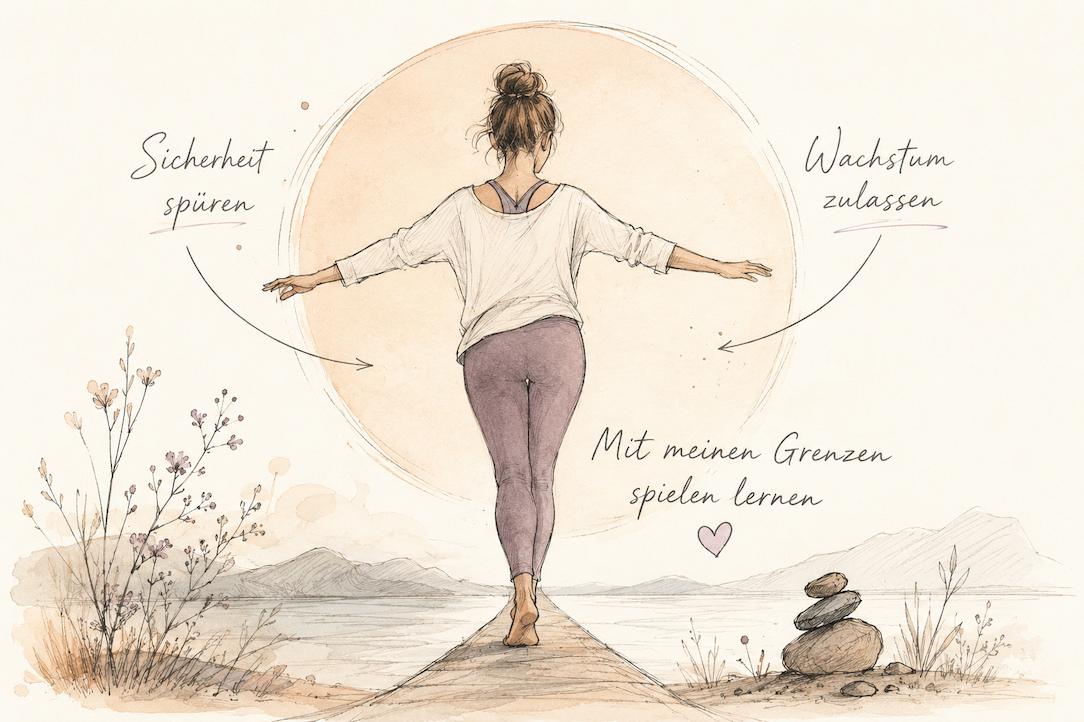
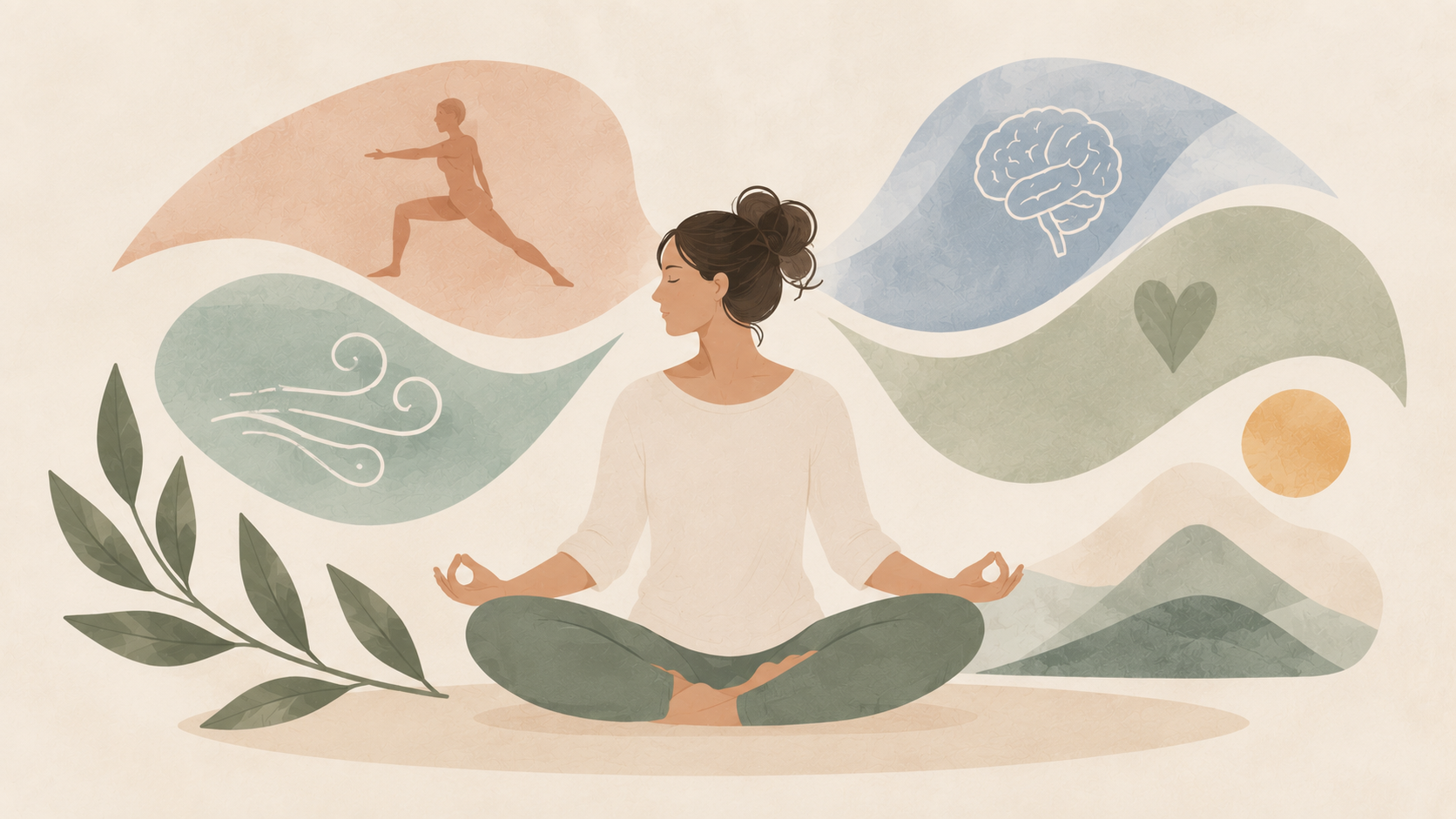
Yoga is a millennia-old philosophical and spiritual tradition in which working with the body is only one part. Breathing exercises, meditation, and concentration are just as much a part of it as engaging with the question of how we interact with ourselves and with others. And it’s not just about whether I can hold a certain posture, but primarily about what I perceive during it. How do I deal with exertion? Do I actually notice when something becomes too much for me? Can I perceive a boundary – and am I allowed to respect it? What happens if I don’t try to do something particularly well? Can I stay with myself, even though others around me are doing something completely different?
An asana can, of course, still be a physical exercise. But it can simultaneously become a space where I observe myself and perhaps even learn something about my habitual patterns. And for that, the posture doesn’t have to look particularly demanding or impressive. On the contrary: sometimes the most interesting things happen in Yoga precisely when hardly anything is happening externally.
And What Does That Have to Do with Yoga Therapy?
Yoga can also be used therapeutically.
In Yoga therapy, Yoga is specifically used to support people with a concrete health concern – both physically and psychologically. The starting point is not a specific Yoga class or sequence of exercises, but the individual: their current situation, their complaints and limitations, but also their resources and goals. This leads to a practice that is specifically selected and adapted. Which asanas are useful? How might they need to be modified? What role can breathing exercises, meditation, relaxation, or body awareness play? What is helpful at the moment – and what might not be?
Yoga therapy is not a rigid program. The practice can change as the person’s situation changes. And it by no means has to take place only in individual settings. A group can also work therapeutically with Yoga if it focuses on a common health concern – for example, back pain, cancer, or depression. Yoga therapy can draw from the entire spectrum of Yoga: from asanas as well as from breathing exercises, meditation, relaxation, body awareness, or philosophical impulses.
Asana as a Tool
We don’t use the body to get into the asana – but the asana to get into the body.
For back pain, the focus might be on mobility, stability, posture, and an appropriate way of dealing with strain. Certain asanas are modified, supported, or perhaps omitted entirely. In the case of cancer, consequences of surgery, limited mobility, fatigue, or current resilience can play a role. At the same time, it can also be about finding a different connection to one’s own body after a period full of examinations and treatments.
In depression, however, completely different questions can become important. Is activation or rest more needed right now? How much demand is helpful? Movement, breath, perception, and meditation can be weighted very differently. And in trauma-sensitive Yoga, the focus shifts again. Here, it’s not just about what we practice, but crucially, how a practice is offered: with choices, self-determination, an invitation to one’s own perception, and as little pressure as possible to do something in a specific way.
These are very different applications. What they have in common is that the person is not adapted to a predefined Yoga practice, but the Yoga practice is adapted to the person.
Yoga Doesn’t Have to Keep Up
So perhaps Yoga doesn’t have to try to keep up with the next fitness trend.
If Pilates is currently the trendier workout: wonderful. That takes nothing away from Yoga. On the contrary. Perhaps it even creates space to perceive Yoga again in its full breadth – as a practice in which breath, perception, meditation, philosophy, and how we deal with ourselves have their place just as much as movement.
For me, this is precisely where the future of Yoga therapy lies: in selecting from the diversity of Yoga what can be helpful for a person in their respective situation.
Perhaps Yoga doesn’t have to become “in” again. Perhaps it can simply be more Yoga again.