Why increasing strain, long waits for therapy, and alienation from one’s own body are interconnected—and the role yoga can play in this.
Mental illnesses have long been one of the greatest health challenges of our time. Current data shows a development that is hard to miss.
An analysis published in 2026 in the renowned medical journal *The Lancet* concludes that the number of mental disorders worldwide increased significantly between 1990 and 2023. Researchers estimate that around 1.17 billion people were affected by a mental disorder in 2023. Particularly sharp increases are evident in anxiety disorders, depression, and eating disorders, among others.
The trend among young people is particularly concerning. According to the “Youth in Germany 2026” study, 29 percent of 14- to 29-year-olds report needing psychological help. This means the psychological strain on this age group has reached a new high.
At the same time, the healthcare system is reaching its limits in many places. Therapy slots are scarce, and waiting times of several months are not uncommon. Although millions of people in Germany suffer from mental illness, many do not receive the support they need in a timely manner. Professional associations also warn that current trends regarding reimbursement for psychotherapy services could further exacerbate the situation.
There is much debate about the causes. Social media, pressure to perform, anxiety about the future, societal crises, and loneliness are frequently cited. All these factors undoubtedly play a role.
And yet, sometimes I have the feeling that we are overlooking an important aspect.
Perhaps we should not only ask why more and more people are developing mental illnesses.
Perhaps we should also ask what we, as a society, have unlearned.
Knowing and feeling belong together
We live in a time when knowledge about mental health is greater than ever before. There are podcasts, books, social media channels, awareness campaigns, and a growing openness regarding mental illness. This represents significant progress. Today, many people know far more about depression, anxiety disorders, or trauma than they did ten or twenty years ago.
And yet the burdens are increasing. This seems contradictory at first. If we know more than we used to, why don’t we automatically feel better? Perhaps the answer lies in the fact that knowledge alone is not enough.
You can understand what stress does to the nervous system and still regularly exceed your own limits. You can know the symptoms of depression and still not notice that you are slipping into a depressive phase yourself. You can read books about mindfulness and still hunch your shoulders, hold your breath, and rush from appointment to appointment all day long.
I write this not only as a psychotherapy and yoga therapist, but also as someone who has lived with depression for many years.
For a long time I thought that, above all, I needed to understand what was going on with me. I read books, analyzed connections and tried to classify my feelings. All of this was helpful. And yet I often felt like an important part was missing.
It was only through yoga that I began to realize how much information my body was already holding for me all the time. I noticed how stress showed up in my breathing, how tension settled in my body, and how often I ignored warning signs. That didn’t mean that everything suddenly became easy. But it was the beginning of a new relationship with myself.
Looking back, I think it’s not just my understanding that has grown. I have learned to feel myself again.
Mental health doesn’t just come from understanding each other.
It also arises from the fact that we feel each other.
The separation of head and body begins early.
If we are honest, many of us learn to ignore our body’s signals as early as childhood. We learn to sit still even when we want to move. We learn to keep going even when we are tired. We learn to meet expectations even when we are under pressure. We learn to pull ourselves together, push through, and keep functioning.
Of course, this does not happen intentionally. Schools, families, and employers often achieve great things under difficult conditions. Nevertheless, the impression often arises that we have to choose between thinking and feeling—as if the mind were responsible for important decisions while the body were merely a secondary matter.
And yet, we need both.
We learn to analyze problems and find solutions. We learn to perform and achieve goals. Yet, far less often do we learn to perceive how stress feels in the body, to recognize the signs of being overwhelmed, or to notice when something doesn’t feel right for us.
I encounter this time and again in my work as a naturopath for psychotherapy and a yoga therapist. Many people can explain very precisely why they are exhausted; they can analyze the causes of their stress and understand the connections. At the same time, however, they often only realize quite late just how exhausted they actually are.
The body often sends signals long before a crisis becomes visible. Yet if we have never learned to perceive these signals, we lose an important connection to ourselves.
The body often knows before the mind
Modern trauma, stress and neuroscience shows more and more clearly that mental health does not arise exclusively in the mind. Thoughts, feelings, physical sensations and the nervous system influence each other.
Our bodies constantly register what is happening around us. They respond to safety and insecurity, connection and loneliness, overwhelm and relief. This often happens long before we consciously think about it. Shallow breathing, tense shoulders, tightness in the chest, a lump in the throat, or a queasy feeling in the stomach are not merely physical phenomena. They are sources of information. They tell us something about how we are feeling.
This does not mean that every mental illness is caused by a lack of body image. Mental health is complex. Biological, social, familial and societal factors interact. Nevertheless, alienation from one’s own body seems to me to be an important blind spot of our time. Because if you lose connection to your own signals, you often also lose the ability to react to yourself early on.
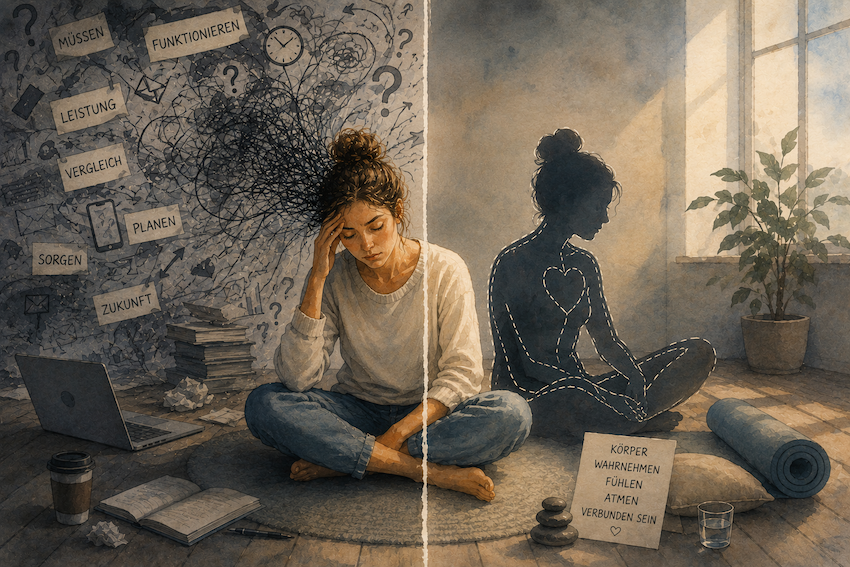
More therapy places are important – but they don’t solve everything.
Long waiting times for therapy appointments are a serious problem. People suffering from depression, anxiety disorders, or the effects of trauma need professional support. Psychotherapy can change lives. It helps individuals process distressing experiences, understand underlying connections, and find new ways of relating to themselves. I have personally benefited from psychotherapy; it played a vital role in my own journey, and I am convinced of its value.
At the same time, I believe we often address mental health too late—only after people have already become ill.
We talk about therapy. We talk about diagnoses. We talk about treatment. We speak far less often about how people can learn to become aware of themselves sooner. How they can recognize that they are constantly overextending themselves. How they can realize that they need support. How they can learn to pause in time.
The answer to the mental health crisis will not lie solely in creating more therapy places—important as that is. It will also lie in enabling people to regain access to something many have lost: the ability to perceive themselves. Mental health does not begin only during a therapy session; it often begins long before that.
Why Bodywork and Psychotherapy Belong Together
In my practice, I frequently encounter people who have already gained a great deal of understanding. They are familiar with their history, their patterns, and often the reasons behind their struggles. Some have read books, listened to podcasts, or already had experience with therapy.
Nevertheless, I keep hearing statements like:
“I actually know what’s good for me—but I don’t do it.”
Or:
“I often only realize much too late that I’ve pushed past my limits.”
This is precisely where it becomes evident that mental health is not merely a matter of knowledge. It is also about restoring the connection between understanding and experiencing.
In recent years, it has become increasingly clear that mental health requires both so-called top-down and bottom-up approaches. Top-down means working through language, reflection, insight, and understanding. Bottom-up means involving the body: breathing, movement, body awareness, and nervous system regulation. In my view, both are necessary, because psychological distress manifests not only in thoughts but also in sleep problems, muscle tension, exhaustion, inner restlessness, breathing patterns, or the feeling of not being truly present.
People dealing with chronic stress or traumatic experiences, in particular, often report that—while they understand what happened to them—they still do not feel safe or connected. Bodywork can be a valuable complement in this regard; not as a substitute for psychotherapy, but as an extension of it. After all, understanding alone is sometimes not enough. The body, too, needs to be able to experience safety, a sense of agency, and connection.
The good news is that our nervous system retains the ability to learn throughout our lives. People can relearn how to perceive their body’s signals, self-regulate, and respond to their own needs with greater compassion.
What yoga can achieve here
When I speak of yoga, I do not mean acrobatic poses or perfect sequences of movement. Nor do I mean that yoga can cure mental illnesses. From my perspective, what yoga can achieve is something else.
Yoga creates a space where people can learn to perceive themselves again.
The breath.
The body.
Their own limits.
Their own needs.
Their own inner reaction to what is happening in the moment.
In trauma-sensitive yoga, in particular, the goal is not to achieve or perform. It is about having experiences. Sensing what a conscious decision feels like. Discovering that you can influence your own state. Noticing that the body can be a place of safety and orientation, not just a site of stress and tension.
After some time, many people do not report that all their problems have vanished. Instead, they report realizing sooner when things become overwhelming. Being better able to care for themselves. Feeling closer to themselves again.
That may sound unspectacular. Yet, that is often exactly where change begins.

Yoga doesn’t belong only on the mat.
Perhaps this is where one of the greatest misconceptions about yoga lies. Its true impact often unfolds not during a yoga class, but in the many small moments in between. When we notice that our breathing has become shallow. When we realize we are exhausted. When we pause briefly before reacting automatically. When we set a boundary. When we ask ourselves: What do I actually need right now?
These moments sometimes last only a few seconds. And yet, they can make a huge difference.
That is why yoga does not begin on the mat, nor does it end there. At its core, it is about the ability to connect with oneself again and again—not just during a practice session, but in the midst of everyday life. Perhaps that is precisely one of its greatest strengths.
Building bridges while people wait for help
For many people, there is another challenge: They know that they need support, but cannot immediately find a place for therapy. Yoga, breathing exercises, mindfulness or other body-oriented approaches can play an important role, especially at this time. Not as a replacement for psychotherapy and not as a quick fix. But as an opportunity to build up resources, strengthen self-regulation and regain contact with yourself. Sometimes this is an important first step. Sometimes it helps people not only to endure the waiting time, but also to actively do something for themselves.
Why Yoga Belongs in Schools
When we talk about mental health, we should also ask ourselves where prevention actually begins.
For me, it doesn’t begin in doctors’ offices or therapy rooms. It begins where children spend a large part of their day: at school.
We teach children mathematics. We teach them reading, writing, and foreign languages. Yet, they rarely learn what stress feels like in the body, how to recognize when they are overwhelmed, or how to self-regulate when it all becomes too much.
And yet, these are skills that will stay with them throughout their lives.
For me, yoga in schools is not about training children to become little yogis or practicing perfect poses. It is about equipping them with tools—tools for self-awareness, concentration, self-regulation, and resilience.
At the same time, we must not overlook an important point: teachers need these tools, too.
Many teachers today support children with widely varying needs. They meet high demands, bear responsibility, and often face considerable pressure themselves. Those who are there for others every day need ways to take good care of themselves as well.
That is precisely why, in my view, the goal of school yoga is not merely to empower children. It is about creating a culture that takes the mental health of everyone involved into account. When children and adults learn to recognize signs of stress, self-regulate, and treat themselves with mindfulness, it is not just individuals who benefit, but entire school communities. Perhaps this is one of the most important health competencies of the 21st century.
A holistic view of mental health
The rising number of mental health issues should serve as a wake-up call. More therapy places are urgently needed. Quality psychotherapeutic care is indispensable. Yet, perhaps it is not enough to focus solely on treatment.
We may also need to discuss how people can maintain a connection with themselves—how children can learn to recognize their needs, how adults can spot warning signs earlier, and how we can support people in taking good care of themselves before a crisis arises, rather than waiting until they are already in one to seek help.
It is not a matter of pitting the body against the mind.
Quite the opposite.
Our mind helps us recognize connections, make sense of experiences, and make conscious decisions. Our body, in turn, constantly provides us with information about how we are doing, what we need, and where our limits lie.
Mental health does not originate solely in the mind. Nor does it originate solely in the body. It emerges where the two come together.
Perhaps the answer to the growing psychological burden on our society lies not only in more therapy places, important as these are. Maybe it also lies in helping people to perceive themselves again – with their thoughts, their feelings and their physical sensations.
Because the future of mental health may not lie in the choice between head and body. But in connecting the two again.