Perhaps you know the feeling: you wake up in the morning, and even before you pick up your phone, that heaviness is already there. A vague sense of tension that cannot be traced back to any specific event. As if your body had already read the news before you did.
Many people are currently reporting exactly this: a kind of constant exhaustion that feels different from ordinary tiredness. An inner agitation that doesn’t fully go away, even on vacation. A sensation of tightness in the chest. Chronic tension in the shoulders. Sleep that no longer leaves you feeling truly rested.
This is not a sign of weakness. It is the response of a nervous system carrying too much—for too long. The world’s negativity takes hold: in the tissues, in the breath, in one’s posture. And at some point, simply “consuming less news” is no longer enough. What the body needs is active care. A place it can return to.
Yoga philosophy has recognized this state for millennia.
The four ages – a cosmic rhythm
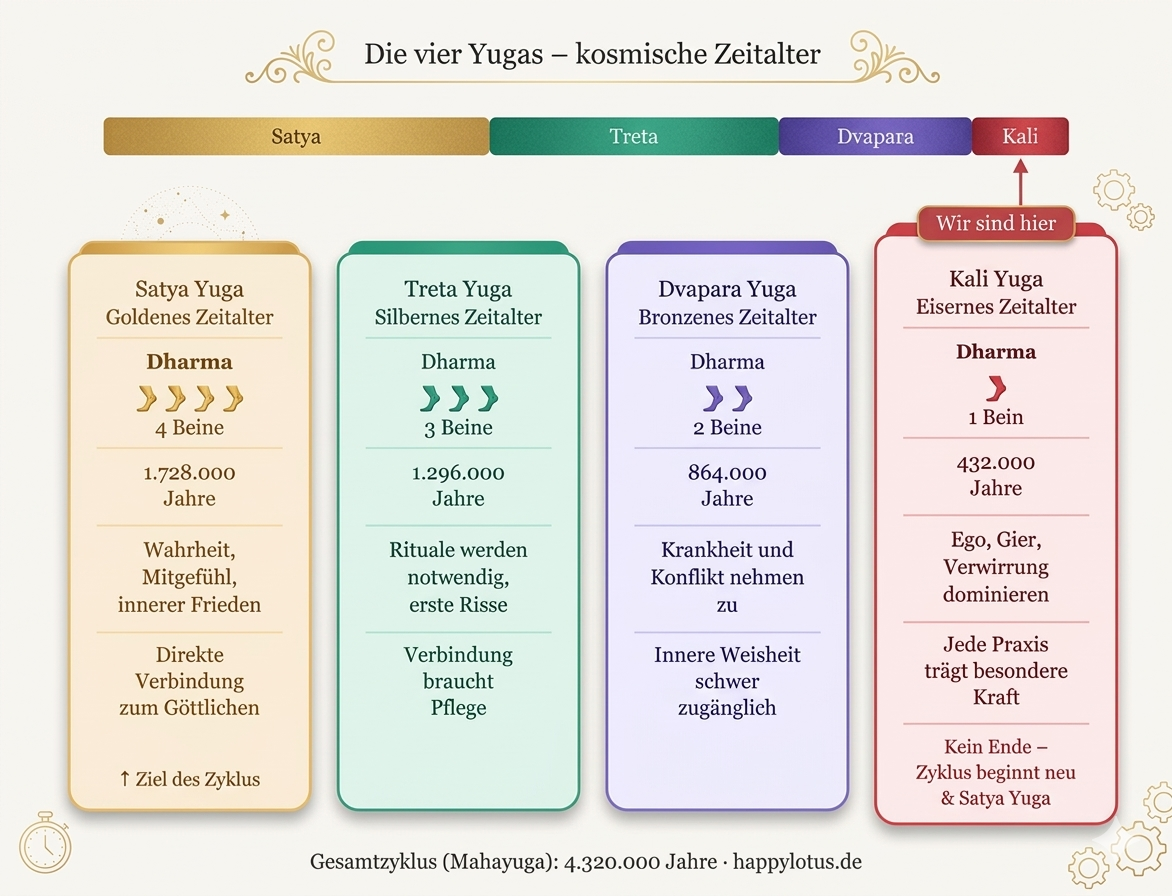
In the Hindu worldview, the Earth repeatedly passes through a great cycle—the Mahayuga—consisting of four ages, the Yugas. Each age has its own character and its own quality of consciousness and social coexistence.
Satya Yuga – the golden age
Dharma—a Sanskrit term that can only be translated approximately as right action, inner law, or the question “What serves the whole?”—stands on four legs in the Satya Yuga. Human beings live in direct connection with the Divine, with nature, and with one another. Truth, compassion, and inner peace characterize collective life.
Treta and Dvapara Yuga – the creeping erosion
Step by step, Dharma loses one leg after another. Inner law becomes external rule. Rituals become necessary to maintain the connection to the sacred. Illness, suffering, and conflict increase. What was once taken for granted—cooperation, trust, care for one another—must now be consciously cultivated.
Kali Yuga – the iron age
Dharma balances on a single leg. Ego, greed, and confusion dominate collective affairs. The connection to inner wisdom is the most difficult to maintain. According to traditional calculations, we have been living in this age for about 5,000 years—and it is described as the darkest. After this, the ascent begins: back to the light, back to Satya Yuga, the Golden Age. The cycle turns.
No failure – and no single instance of blame
When we look at the world – war, ecological collapse, the rise of authoritarian leaders – the human reflex is understandable: we look for those responsible. We name names. And yes: there are people who cause enormous suffering through their decisions, and that deserves to be clearly identified.
At the same time, yoga philosophy invites us to consider another perspective. The Kali Yuga is not the failure of a single generation. It is a cycle, as natural as winter. Individuals help drive it forward—but the collective ego, collective greed, and collective fear are energies greater than any single person.
This perspective does not absolve us of political responsibility. But it prevents us from getting stuck in the exhausting cycle of outrage, powerlessness, and renewed outrage.
Collective trauma – when history happens between us
When we look at the world – war, ecological collapse, the rise of authoritarian leaders – the human reflex is understandable: we look for those responsible. We name names. And yes: there are people who cause enormous suffering through their decisions, and that deserves to be clearly identified.
At the same time, yoga philosophy invites us to consider another perspective. The Kali Yuga is not the failure of a single generation. It is a cycle, as natural as winter. Individuals help drive it forward—but the collective ego, collective greed, and collective fear are energies greater than any single person.
This perspective does not absolve us of political responsibility. But it prevents us from getting stuck in the exhausting cycle of outrage, powerlessness, and renewed outrage.
Three exercises for home: building inner resources
The following exercises were selected to regulate the nervous system, strengthen inner stability, and foster connection—with yourself, with your breath, and with something greater than the day’s news.
Exercise 1: Nadi Shodhana – Alternate Nostril Breathing
(10 – 15 minutes)
Nadi Shodhana, the alternate-nostril breathing technique, is considered one of the most effective pranayamas for calming the nervous system. It balances the two major energy channels—Ida and Pingala, the lunar and solar principles within us—and signals to the nervous system: It is safe. You can let go.
Sit upright with your eyes closed. Place your right hand in Vishnu Mudra: fold the index and middle fingers, and extend the thumb, ring finger, and little finger. Close your right nostril with your thumb and inhale through the left. Open the right nostril and exhale. Then reverse the process: inhale through the right and exhale through the left. That constitutes one round. Perform 10 rounds.
Afterwards, remain in silence for a moment. What has changed? What has settled?
Variation for the experienced: Close the right nostril with your thumb and inhale through the left for a count of four. Close both nostrils and hold for a count of four. Open the right nostril and exhale for a count of eight. Then reverse the process: inhale through the right, hold, and exhale through the left. That constitutes one cycle—perform ten rounds.
Kali Yuga context: In times of collective overwhelm, the nervous system requires active regulation—not more input, but a conscious pause. Nadi Shodhana is that pause.
Exercise 2: Balasana with Mantra – Arriving in the Body
(10 minutes)
Collective trauma often manifests as dissociation—our minds are everywhere except in our own bodies. Balasana, or Child’s Pose, is one of the simplest and most effective practices for returning to the body.
Kneel on the mat with your big toes touching and your knees apart. Lean forward, letting your forehead rest on the mat or a cushion. Extend your arms forward or place them alongside your body. Allow the weight of your head, shoulders, and back to sink into the floor.
Now apply the mantra “So Hum” to your breath: “So” on the inhalation, “Hum” on the exhalation. The translation is “I am that”—a reminder of who you are, beyond news, worries, and to-do lists. Remain in this state for five to ten minutes.
Connection to the Kali Yuga: When the outer world is loud, we need an inner sound. When the collective nervous system is dysregulated, every moment of genuine bodily presence becomes a small act of healing—for you and, in a figurative sense, for the collective.
Exercise 3: Journaling – Being a witness without judgment
(5 – 10 minutes)
One of the most powerful resources in collective trauma is witnessing ability – the ability to perceive one’s own experience without being overwhelmed by it or pushing it away. Journaling can strengthen this skill.
Take a notebook and write for five to ten minutes without censoring yourself. Start with the sentence: “What the world is doing to me right now is…” – and write whatever comes to mind. No structure, no goal, no sugarcoating.
Then set your pen aside for a moment. Take three deep breaths. Afterward, write: “What is more stable within me than all of that is…” – again, without censoring yourself. Perhaps not much comes to mind. Perhaps what emerges surprises you.
Kali-Yuga reference: Collective trauma makes us passive recipients of history. Journaling gives us back authorship – over our inner lives, if not over the external circumstances.
Practice as protection—and as a silent response.
I do not wish to conclude with a sense of false lightness. The world is heavy—some days more so than others. And it would be dishonest to offer yoga as a solution to issues that require political, social, and ecological answers.
But I believe—out of conviction and from daily experience in my work—that people who have access to their inner stability engage with the world differently. Less reactively. More present. More capable of truly listening, truly acting, and truly loving.
This is the protection yoga offers: not shielding yourself from the world, but rooting yourself within. So that you are not swept away—by negativity, by outrage, by exhaustion—but can stand firm.
In the Kali Yuga, this is no small gesture. It is a quiet, inner response to a loud, outer age.