“I don’t even know which way is up anymore.”
“I’m just functioning.”
“As soon as I settle down, I start to cry.”
I regularly encounter sentences like this in my work as a trauma and yoga therapist, in individual sessions and in groups. Many people come wanting to “just switch off”. But there is often something deeper behind it: excessive demands. Constant tension. Helplessness.
They feel exhausted, driven, and cut off from within. And they are not alone in this.
We live in an era where constant availability, pressure to perform, and uncertainty are part of everyday life. People who give a great deal—whether to their families, in their careers, or while providing care or support—often reach a point where they realize: I have lost myself.
When the body sounds the alarm
From the perspective of yoga therapy and trauma therapy, overwhelm is not a purely psychological phenomenon. It manifests in the body—as a state of tension, sleep disturbances, irritability, or withdrawal.
Chronic stress activates the nervous system and keeps it in a state of high alert. The body sends signals—yet we often only heed them when we have reached our absolute limit. This is precisely where trauma-informed bodywork comes in: focusing on sensing, regulating, and reconnecting.

What yoga philosophy says about this
The ancient yoga texts speak very clearly about conditions that we would today describe as “stress” or “burnout”. Patanjali cites avidya – ignorance or forgetting of our true self – as one of the causes of suffering. This also means: the loss of access to our bodies, our needs, our inner boundaries.
“Yoga citta vritti nirodhah” – Yoga is the settling of the inner fluctuations.
Yoga helps us become quieter again—not passive, but clear.
In yoga therapy we use targeted exercises, breathing work and mindful movement to find our way back from inner chaos to a state of presence, security and self-efficacy.
Three simple exercises for when you feel overwhelmed
You don’t have to attend a 90-minute class to start practicing yoga. Especially during stressful times, what you need are small, realistic prompts that bring you back into your body.
1. Breath anchor: Exhale for longer
Sit comfortably. Feel your feet. Breathe in slowly (count to 4), then breathe out even more slowly (count to 6).
A prolonged exhale calms your nervous system and grounds you.
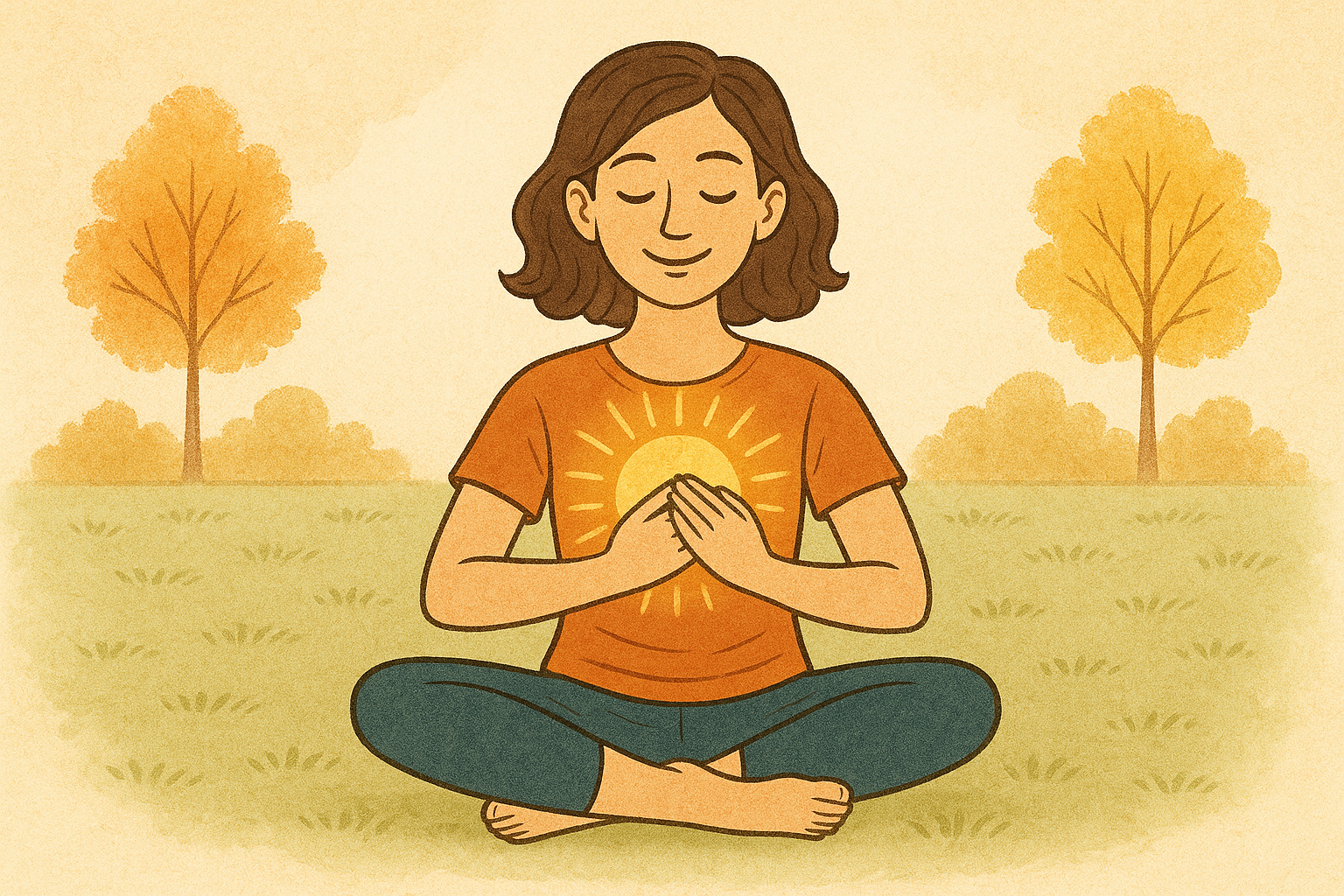
2. Hand on heart
Place your hand on your chest and feel the warmth. Become aware of your breath. Say to yourself inwardly: “I am here.”
This simple gesture creates connection and a sense of safety.
3. Shake & Stillness
Stand up and give your body a loose shake—arms, legs, shoulders. Allow yourself to make sounds; exhale. Afterwards: stand still and sense the after-effects.
Movement releases tension; becoming still afterwards deepens regulation.
Gentleness instead of self-optimization
I often hear: “I really ought to…”, “I can’t do this properly…”
But yoga is not a competition—nor is it a technique for self-optimization.
Yoga therapy is not about functioning better, but about becoming softer. It is not about achieving more, but about feeling more.
Maybe your yoga today is: breathing. Or sit for five minutes. Or not reacting to everything immediately.
If you feel helpless …
… then that is not a sign of weakness. It is a sign that you have been strong for too long.
In my work as a trauma therapist using a yoga-therapeutic approach, I see every day how powerful it is when people reconnect with themselves.
Yoga—when understood correctly—is not a withdrawal from life.
It is a reconnection with your own inner self. With the part of you that is whole, calm, and complete.
“Yoga begins right where I am – not where I was yesterday or where I long to be.”
– Judith Hanson Lasater
Trauma often begins more quietly than we think.
Many people shy away when they hear the word “trauma.” They think, “I haven’t experienced anything like that,” or “Mine isn’t severe enough.” Yet trauma is not a competition in suffering. It is not about what happened, but rather how the body and nervous system reacted to it. Professionals distinguish between “Big T” trauma—clearly identifiable, often life-threatening events—and “small t” trauma, which can arise from repeated overwhelm, emotional neglect, or a lack of safety. Both can leave their mark. And both deserve to be seen—without comparison, without judgment.
You don’t have to do this alone.
Perhaps, as you read this, you feel a quiet “yes.” Or perhaps an “I don’t know if I can do this.”
Both are welcome.
I would be happy to support you—whether in an individual trauma or yoga therapy session, a trauma-sensitive group setting, or simply during an introductory conversation.