

Body-Based Support in Depression: Reflections from the German Depression League’s Thementag
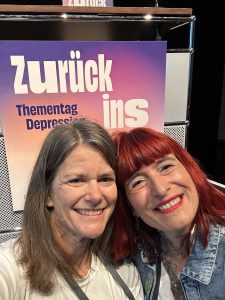
On October 25th, I took part in the Thementag Depression hosted by the German Depression League. More than 200 people attended: individuals with lived experience, relatives, therapists, physicians, social workers, facilitators, and people who simply care. The atmosphere was attentive, open, and grounded.
I had the opportunity to guide the group in a short arrival practice at the beginning of the day. Just a few minutes to notice the body:
How am I sitting?
How is my breath moving today?
Do I feel tense, tired, steady, restless?
No technique.
No goal.
Just a moment of contact.
Many participants later said that this simple start helped them to actually arrive — before stepping into talks and emotional content. I see this often: we tend to “deal with the body later.” But that first moment of sensing ourselves can make everything else more accessible.
Later in the event, I led a session on trauma-sensitive yoga. We worked with small, manageable movements, clear pacing, and real choice. Not every nervous system feels safe in stillness or in focusing inward — so in trauma-sensitive yoga we create an environment where each person can stay in touch with their own boundaries.
This day again highlighted something I see often in depression support:
Body-based approaches are still underrepresented.
When we talk about depression, we mostly talk about thoughts, feelings, behavior patterns, and social factors. All of that matters deeply.
But depression also shows up in the body:
- in a breath that becomes smaller and narrower
- in shoulders that draw inward
- in fatigue and low muscle tone
- in a slowing of movement
- in a withdrawal from physical contact and presence
So when we speak about depression, we are also speaking about body states.
This does not mean yoga or bodywork is a replacement for therapy or medication. They are not alternatives — they are complements.
Body-oriented practices can help a person:
- stay connected to the present moment,
- recognize what is happening internally before it escalates,
- and slowly rebuild a sense of self-contact.
Often, something very small is enough:
- feeling the feet on the floor,
- resting a hand on the chest,
- or taking one slow exhale.
Not to relax.
Not to perform.
But simply to notice: I am here.
The aim is not to activate or energize the person.
The aim is to create enough connection to feel oneself again — gently, safely, without pressure.
The Thementag reminded me how much interest there is in this approach — and how much space there still is for education. My hope is that bodywork becomes a more natural part of supporting people living with depression. Not as another task or expectation, but as a way to make daily life a bit more navigable.
I am grateful I could contribute to this event.
And I am committed to continuing this work — slowly, steadily, together.




Als AddOn möchte ich das Yoga-Englisch-Angebot hier nicht vergessen: Gern auch als Newsletter mit wertvollen Inspirationen und Lebenserfahrungen 😊
I met Anna at the beginning of the Corona period and since then I have been booking online via Happy Lotus. I like her yoga style - depending on the needs and daily offer at different levels - rest, balance and strength training at the same time. Her diverse life experiences and her commitment to people can also be felt on the yoga mat: probably a calling! And so I always say goodbye to the yoga classes with a smile and gratitude. As an add-on, I don't want to forget the Yoga English offer here: Gladly also as a newsletter with valuable inspiration and life experiences 😊
den Einschränkungen, durch Corona .
Ich habe durch Anna ein ganz besonderes Yoga kennengelernt. Sie geht immer auf ihr Gegenüber ein. Die Übungen sind nicht zu lasch und nicht zu anstrengend, sondern es ist eine gute Mischung.
Und... Anna vermittelt alles mit so viel Liebe und Ruhe.
DANKE an die beste Yogafrau, die es gibt.
Happy Lotus, thank god there is Anna! I've been in Anna's yoga studio for over 2 years now and I'm soooo glad I have her. Especially the online classes were my salvation in Covid times. I have an online flat rate with Anna and can therefore go to one of her classes at any time. And I use that extensively. I've tried different teachers before, but I never stuck with them for long. Not so with Happy Lotus. Every lesson is a blessing. You can follow Anna's voice with your eyes closed. Anna also gives one-to-one sessions and has created a great personalized short sequence for me against my neck pain, I do it almost every day. Anna teaches in German and in English, I have attended every one of her classes and I am absolutely happy with Happy Lotus. All the stars in the world and a very clear recommendation from me!
Möchte die Trainings nicht mehr missen, absolut wohltuend - tolle Mischung aus Dynamik und Entspannung unter sehr sympathischer und kundiger Anleitung von Anna!!
How do I deal with the death of my former best friend?
Santi is dead. Writing this sentence is still hard, reading and believing it is even…
Now available: Lovely Gift Certificates
Give the gift of Yoga to your friends and loved ones! Ideal for anniversaries, birthdays…
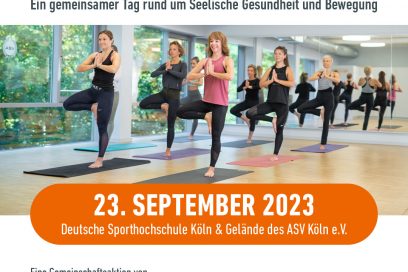
Free Event: Fit for the soul
Let's celebrate mental health and sports When: 23 Sept. Where: Deutsche Sporthochschule Köln and ASV Köln e.V. Sport…

